
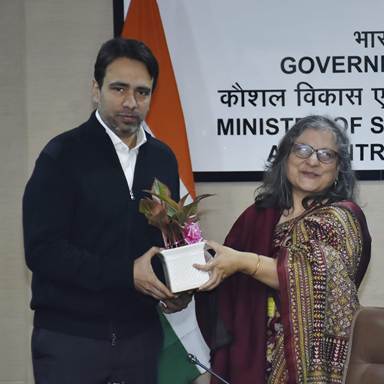
The Ministry of Skill Development and Entrepreneurship concluded a week-long Kaushal Manthan on December 31, setting a clear and outcome-oriented skilling roadmap for 2026. The intensive consultations, held from December 23 to 31, brought together senior officials from across ministerial divisions, institutions and key stakeholders to identify priority reforms aligned with national development goals.
The concluding session was chaired by the Minister of State for Skill Development and Entrepreneurship and Education, who emphasised the need to move decisively into the next phase of skilling reforms with sharper focus on measurable outcomes, stronger convergence with State Governments and industry, and more rigorous monitoring of training quality, assessments and certifications. The deliberations culminated in the finalisation of Skill Resolutions for 2026, which will guide policy action and programme implementation over the coming year.
Discussions during the Manthan centred on building a robust, responsive and future-ready skilling ecosystem capable of meeting the demands of a rapidly evolving labour market. A major thrust was placed on strengthening institutional mechanisms while simultaneously simplifying systems to improve efficiency and ease of doing business. Among the key proposals was the introduction of outcome-based grading mechanisms for Industrial Training Institutes to drive quality improvement, along with greater delegation of powers to regional and institutional levels.
Participants also deliberated on the reorganisation and strengthening of Sector Skill Councils, including the need for regular reviews, clearly defined key performance indicators and closer alignment with industry needs. Continuous curriculum upgradation in response to technological change and emerging skill requirements was highlighted as essential, alongside deeper industry co-creation to ensure training remains relevant and adaptable.
Another central theme was the creation of seamless learning and career pathways across skill levels. Emphasis was laid on enabling smooth transitions from school to post-school education, supporting dropouts, working professionals and lifelong learners through flexible credit frameworks and mobility across programmes. Strengthening apprenticeships as a primary school-to-work pathway and integrating micro, small and medium enterprises into national skilling and apprenticeship frameworks were reiterated as critical priorities.
The Ministry also reviewed commitments made during the recent conference of chief secretaries, including the establishment of a National Federated Skill and Workforce Registry, operationalisation of a National Trainer Framework, and time-bound integration of MSMEs into skilling initiatives. These measures are intended to improve transparency, portability and coordination across the skilling ecosystem.
The Kaushal Manthan reaffirmed the Ministry’s commitment to sustained and structured consultations with State Governments, deeper and continuous industry engagement, and stronger inter-ministerial and institutional convergence. These common levers are expected to underpin the effective implementation of reforms, ensure alignment across stakeholders and position India’s skilling ecosystem to support growth, employment and competitiveness in the years ahead.