
India is accelerating efforts to eliminate legacy waste dumpsites as part of the next phase of the Swachh Bharat Mission, with a clear national target of achieving Zero Dumpsites by October 2026. To fast-track this objective, the Government of India launched the Dumpsite Remediation Accelerator Programme in November 2025, focusing on the scientific clean-up of decades-old waste accumulations across urban areas.
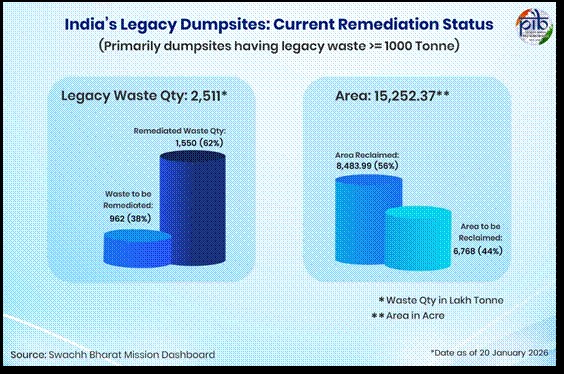
Across the country, 2,479 major dumpsites containing 1,000 tonnes or more of legacy waste have been identified. Together, these sites hold an estimated 25 crore metric tonnes of waste spread over nearly 15,000 acres. At present, remediation work is underway at 1,428 dumpsites, and more than 61 per cent of the total legacy waste has already been processed.
Under the programme, 214 high-impact dumpsites have been prioritised as they account for nearly 80 per cent of the remaining legacy waste. These sites span 30 States and Union Territories and cover 200 Urban Local Bodies, with an estimated 8.6 crore metric tonnes of accumulated waste. Projects worth around ₹6,700 crore have already been approved for these priority locations.
Legacy dumpsites pose serious environmental and public health risks, including groundwater and soil contamination, poor air quality, methane emissions, frequent fires and the spread of disease. The remediation process follows a scientific biomining approach, under which old waste is excavated, stabilised and segregated into reusable material streams.
Inert and soil-like material and construction debris are reused for road construction, embankments and filling low-lying areas. Construction and demolition waste is processed into paver blocks, tiles, bricks and aggregates. Combustible waste is converted into Refuse-Derived Fuel and supplied to cement plants and waste-to-energy facilities as an alternative to coal. Recyclable materials such as plastics, paper, metals and glass are sent for recycling, while biodegradable waste is processed through composting or energy recovery. Only non-reusable rejects are sent to scientific landfills, ensuring that open dumping does not resume.
During 2025 alone, 459 dumpsites across 438 cities in 26 States were fully remediated, clearing 183 lakh metric tonnes of legacy waste. This took the cumulative total to 1,138 dumpsites remediated across 1,048 cities in 29 States, with 877 lakh metric tonnes of waste processed so far. Alongside remediation, strict measures are being implemented to prevent the creation of new dumpsites by ensuring scientific processing of all fresh municipal waste.
The programme is structured around the five-pillar framework of Swachh Bharat Mission Urban 2.0, covering political leadership, public finance, partnerships, people’s participation and robust project management. Senior political and administrative leaders are directly involved in monitoring progress by adopting specific dumpsites. Community engagement is also a key component, particularly for residents living near dumpsites who are most affected by pollution, odour and health risks.
Remediated land is being prioritised for solid waste management infrastructure or the development of green spaces. The wider waste-processing ecosystem under Swachh Bharat Mission Urban 2.0 is also being strengthened through the expansion of Material Recovery Facilities, composting plants, biomethanation units, compressed biogas plants and waste-to-electricity facilities in large cities.
The elimination of legacy dumpsites is expected to deliver long-term benefits, including cleaner air, safer groundwater, reduced fire hazards and the recovery of valuable urban land. By embedding scientific waste management into routine municipal operations, Mission Zero Dumpsites supports sustainable urban development and contributes to the broader vision of Viksit Bharat 2047, aligning urban growth with environmental sustainability, public health and improved quality of life.