
India’s highway travel experience has undergone a quiet but significant transformation over the past year as the Ministry of Road Transport and Highways, in coordination with the National Highways Authority of India, rolled out a series of people centric toll reforms aimed at reducing congestion, improving affordability and enhancing commuter convenience. With rapid expansion of the national highway network, toll plazas had increasingly become pressure points for daily commuters and long distance travellers. The reforms introduced during 2025 have directly addressed these concerns through technology driven solutions and transparent policy measures.
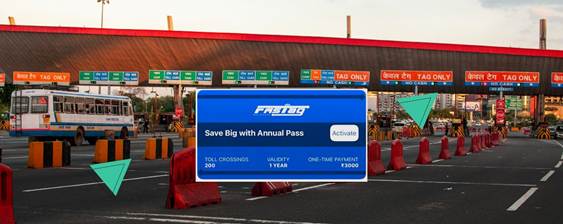
A major highlight of the year has been the introduction of the FASTag Annual Pass on August 15, 2025. Under this scheme, users can pay a fixed amount of ₹3,000 to avail up to 200 toll trips or one year of travel, whichever comes earlier, across 1,159 toll plazas nationwide. The pass has brought predictability and substantial savings for frequent highway users, particularly daily commuters. For many travellers, toll expenses that earlier fluctuated month to month have now been converted into a fixed, manageable cost, significantly reducing financial uncertainty and travel stress.
The impact of the Annual Pass has been swift and widespread. Within a few months of launch, more than 40 lakh passes were sold, with adoption reaching nearly 20 per cent of private car users. Feedback from commuters across states indicates not only reduced daily expenditure but also faster toll crossings and smoother journeys. The scheme has emerged as a practical example of how affordability and efficiency can be delivered together at scale.
Parallel efforts have focused on accelerating the shift towards digital payments at toll plazas. Cash payments, once a major source of delays and disputes, are being steadily phased out through incentives rather than penalties. The earlier provision of charging double the toll for non FASTag payments has been rationalised, with UPI payments now attracting a charge of only 1.25 times the normal toll. This adjustment has made digital payments a viable alternative for those without FASTag, encouraging voluntary adoption while maintaining traffic flow.
Between November 15 and December 10, 2025 alone, toll plazas recorded over 15 lakh UPI transactions amounting to ₹19.44 crore. During the same period, cash collection declined by about 25 per cent, easing congestion and improving transparency. With 98 per cent of vehicles already using FASTag, the remaining gap is being addressed through user friendly digital options rather than coercive measures.
Looking ahead, the future of tolling is being shaped by the rollout of barrier free Multi Lane Free Flow systems. India’s first such system has been awarded for implementation at the Choryasi Fee Plaza on National Highway 48 in Gujarat and is scheduled to become operational in 2026. In addition, five more barrier free tolling projects have been awarded, marking a decisive shift towards highway speed toll collection with no physical barriers and no queues. This is expected to significantly benefit commercial vehicles by reducing fuel loss, travel fatigue and delays caused by repeated stopping and restarting.
The ministry has also addressed a long standing concern of commuters during highway expansion works. Under updated rules, when a highway is being upgraded from two lanes with paved shoulders to four or more lanes, users are required to pay only 50 per cent of the applicable toll during the construction period. This ensures fairness and accountability, recognising the inconvenience faced by road users while improvement works are underway.
In addition to cost and speed related reforms, the FASTag ecosystem itself has been strengthened through targeted measures aimed at preventing misuse and improving grievance redressal. These include:
• One Vehicle One FASTag to prevent duplication and misuse
• Linking FASTag issuance with the VAHAN database to curb vehicle class fraud
• Levy of double fee for loose FASTags to ensure smoother toll operations
• Multiple grievance redressal channels including the 1033 helpline, email support, bank helplines and the RajmargYatra mobile application
Together, these initiatives reflect a governance approach that balances infrastructure growth with everyday user experience. While the changes may not always be highly visible, their impact is evident in shorter queues, predictable toll expenses, faster crossings and improved confidence among road users.
Over the last year, MoRTH’s toll policy reforms have demonstrated that technology, transparency and empathy can coexist in public administration. For millions of commuters who rely on national highways for work, trade and daily life, the journey has become noticeably smoother, more affordable and more reliable, reinforcing the broader goal of ease of living through infrastructure reform.