
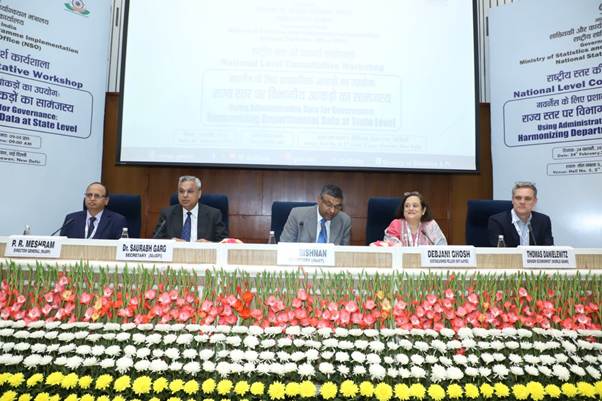
The Ministry of Statistics and Programme Implementation organised a National Level Consultative Workshop on “Using Administrative Data for Governance: Harmonizing Departmental Data at State Level” at Vigyan Bhawan, bringing together States, Union Territories, Central Ministries and key stakeholders to chart a structured roadmap for data-driven governance.
The workshop forms part of the preparatory process for the upcoming National-Level Deliberative Summit titled “Data for Development,” scheduled for April 2026. The summit will build on the outcomes of the 5th National Conference of Chief Secretaries of State and Union Territories held in December 2025 and seeks to establish a coordinated national agenda for strengthening administrative data systems and enabling responsible data harmonisation across departments.
The objective of the workshop was to brief States and Union Territories on the scope, objectives and priority issues that will guide deliberations at State-level internal workshops in the coming weeks. Inputs from these State consultations will feed into the national summit to identify key reform areas for harmonising administrative data.
The inaugural session was addressed by S. Krishnan, Secretary, Ministry of Electronics and Information Technology; Debjani Ghosh, Distinguished Fellow, NITI Aayog; Thomas Danielewitz, Senior Economist, World Bank; and Saurabh Garg, Secretary, Ministry of Statistics and Programme Implementation and Director General Data Governance.
S. Krishnan underscored the need to break data silos across government departments and expand access to data beyond centralised systems to State, district and field-level administrators. He emphasised improving machine readability and enabling real-time analytics to strengthen monitoring and implementation. He stated that interoperability and responsible data sharing are essential for evidence-based governance and timely decision-making.
Debjani Ghosh highlighted the transition from efficiency-driven globalisation to what she described as an era of intelligence. She stressed that data must be converted into actionable insights and that accessibility, interoperability and trust are fundamental to democratising intelligence. She noted that real power lies in ensuring data-driven insights reach the grassroots to support real-time decision-making.
Thomas Danielewitz described data as core infrastructure for the emerging artificial intelligence ecosystem. He highlighted the importance of integrating decentralised digital datasets to reduce compliance burdens for citizens and businesses while unlocking efficiency gains and cost savings.
Saurabh Garg emphasised the need to move from data silos to data synergy, reiterating the Prime Minister’s vision of cultivating civil servants as data enthusiasts. He called upon States to conduct district and State-level consultations to institutionalise data-driven governance practices and ensure that data is actively used rather than stored in isolation.
In his welcome address, P. R. Meshram, Director General Data Governance, Ministry of Statistics and Programme Implementation, stated that administrative data should be treated as a strategic national asset. He stressed the importance of transitioning from siloed datasets to a harmonised, interoperable and securely linked data ecosystem.
The day-long workshop featured four thematic sessions focusing on the practical use of administrative data in governance. Experts from institutions including CEGIS, Ek Step, Microsoft and Bharat Digital, along with senior officials from Karnataka, Odisha, Tamil Nadu and Rajasthan, presented case studies on leveraging routine administrative data for policy insights. Discussions examined common challenges in data reuse and integration, particularly data quality concerns and the institutional frameworks required to enable effective data linkage.
Participants deliberated on operationalising data linkage while adhering to legal and governance safeguards. Foundational requirements for building AI-ready and accessible data ecosystems were discussed, with emphasis on designing datasets that are linkable by design through uniform standards and identifiers.
The workshop concluded with defined timelines leading up to the April 2026 national summit. The deliberations reflected a shared commitment among States, Union Territories and the Centre to build interoperable, AI-ready and securely linked data systems capable of strengthening evidence-based governance and delivering improved public services.