
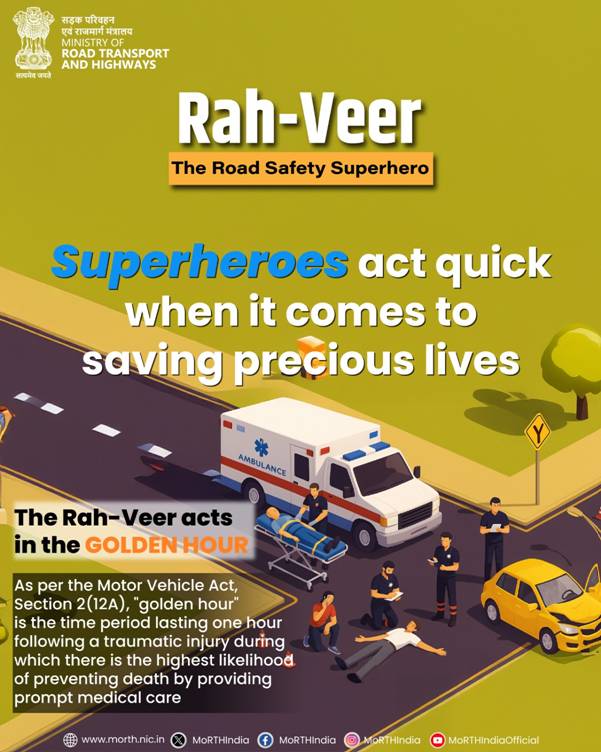
In a decisive step to encourage timely assistance to road accident victims, the Government of India has reinforced legal and institutional safeguards for Good Samaritans under the Rah Veer initiative, ensuring that citizens who step forward to save lives can do so without fear of legal or procedural harassment.
Recognising that the first hour after a serious road accident, known as the Golden Hour, is the most critical for saving lives, the Ministry of Road Transport and Highways notified the Good Samaritan Rules in 2020 under Section 134A of the Motor Vehicles Amendment Act 2019. These provisions are built on the principle that no person who helps an injured road user in good faith should face intimidation, detention or legal entanglements.
Individuals who assist accident victims by arranging transport or taking them to the nearest hospital are recognised as Rah Veers. The law provides them comprehensive protection, ensuring they cannot be compelled to disclose personal details, forced to remain at hospitals, detained by authorities or drawn into legal proceedings unless they voluntarily choose to act as witnesses.
The legal framework clearly defines the Golden Hour as the first sixty minutes following a serious injury, when prompt medical care can prevent death, permanent disability and severe trauma. Importantly, the initiative underlines that no medical expertise or specialised equipment is required to become a Rah Veer. Often, the willingness to act decisively and compassionately is the most critical factor in saving a life.
Under the Good Samaritan Rules, Rah Veers are protected from civil and criminal liability when acting in good faith. They may remain anonymous, provide a single police statement at a time and place of their choosing if they volunteer as witnesses, and are entitled to a simple acknowledgement from hospitals confirming that they brought the injured person for treatment. Hospitals are expressly prohibited from demanding payment from Good Samaritans for emergency care.
Despite significant improvements in road infrastructure, India continues to record one of the highest numbers of road accidents globally. Many fatalities occur not because help is unavailable, but because bystanders hesitate due to fear of police questioning, hospital formalities or legal complications. This hesitation often costs crucial minutes during the Golden Hour, turning survivable injuries into fatal outcomes.
To further encourage public participation, the Rah Veer scheme also provides formal recognition and financial incentives. Any individual who ensures that an accident victim receives medical assistance within the Golden Hour is eligible for a reward of twenty five thousand rupees along with a Certificate of Appreciation. This recognition can be awarded up to five times in a year for repeat acts of courage and compassion.
The initiative aims to foster a national culture where helping accident victims is viewed as a shared civic responsibility rather than a personal risk. By combining strong legal protections with public recognition, the Rah Veer movement seeks to transform public behaviour on roads and reduce preventable loss of life.
The message at the heart of the initiative is clear. In moments of crisis, ordinary citizens can become extraordinary lifesavers. Acting without fear, guided by empathy and protected by law, a Rah Veer can make the difference between tragedy and survival.