

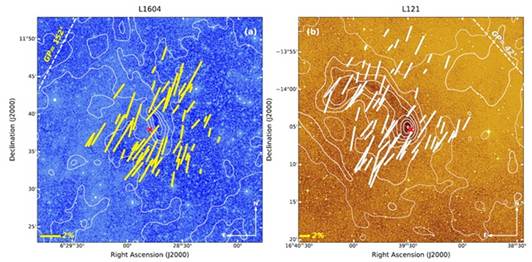
Scientists have made a significant breakthrough in understanding star formation by mapping, for the first time, the magnetic field structures surrounding small molecular clouds near the Milky Way disc, revealing the crucial role of magnetism in regulating the birth of stars.
The study focused on two molecular clouds, L1604 and L121, which serve as modest stellar nurseries located in different regions of the galaxy. While L1604 lies toward the Galactic anticenter, L121 is positioned closer to the crowded Galactic center, offering contrasting environments for analysis.
Magnetic Fields Emerge As Key Force In Star Formation
For decades, astronomers have understood star formation as a balance between gravitational collapse and internal pressure within molecular clouds. However, the new findings highlight magnetic fields as a third and critical force influencing this process.
Scientists from Aryabhatta Research Institute of Observational Sciences and Assam University used advanced R band polarimetry techniques to detect how starlight becomes polarized when passing through dust grains aligned by magnetic fields. Observations were conducted using the ARIES Imaging Polarimeter mounted on the 104 centimetre telescope at Nainital.
By analysing thousands of polarization measurements, researchers were able to trace and map the otherwise invisible magnetic field structures, effectively revealing the “skeleton” of magnetic fields surrounding the clouds.
Distinct Characteristics Of Two Molecular Clouds
The study found notable differences between the two clouds in terms of structure, mass and magnetic behaviour.
L1604 is located at a distance of around 816 parsecs and is relatively dense and massive, containing sufficient material to potentially form a large number of stars. In contrast, L121 lies much closer at approximately 124 parsecs and is less dense and less massive.
Despite its lower density, L121 exhibits a stronger and more orderly magnetic field, suggesting that it has not yet undergone significant gravitational collapse. This orderly magnetic structure indicates an earlier stage of star formation activity.
Magnetic Fields Dominate Over Gravity At Larger Scales
The analysis showed that both clouds are magnetically sub critical, meaning that magnetic fields are strong enough to counteract gravitational collapse across the broader cloud structure.
Magnetic energy in both clouds exceeds turbulent kinetic energy, which in turn is greater than gravitational energy at the outer envelope level. This indicates that magnetic fields play a dominant role in stabilising these regions and slowing down the star formation process.
However, within dense cores located deep inside the clouds, gravity may still overcome magnetic resistance. These cores are likely to become the primary sites for future star formation.
Insights Into Galactic Star Formation Mechanism
The findings provide a deeper understanding of how star formation is regulated within galaxies. By demonstrating how magnetic fields wrap around and permeate molecular clouds, the study shows that magnetism acts as a controlling force, preventing rapid and uncontrolled star formation.
This mechanism ensures that galaxies do not convert all available gas into stars at once, maintaining a gradual and sustained star formation process over millions of years.
Advancing Astrophysical Research
The research positions L1604 and L121 as important natural laboratories for studying the interaction between gravity and magnetism in space.
By revealing the delicate balance between these forces, the study contributes to a broader understanding of the fundamental processes that govern the evolution of galaxies and the formation of stars.
The findings mark a significant advancement in observational astrophysics, offering new insights into the invisible forces shaping the universe.