

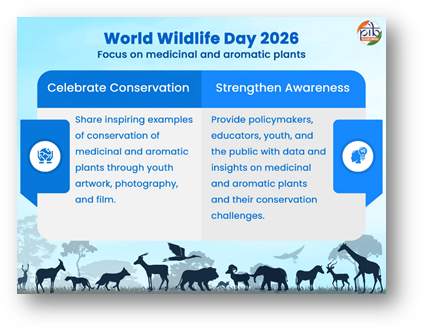
India marked World Wildlife Day on March 3, 2026 with a strong focus on medicinal and aromatic plants, highlighting their critical role in healthcare, heritage preservation and rural livelihoods under the global theme Medicinal and Aromatic Plants Conserving Health Heritage and Livelihoods.
World Wildlife Day is observed annually on March 3 to commemorate the adoption of the Convention on International Trade in Endangered Species of Wild Fauna and Flora, reinforcing global commitment to ensuring that wildlife trade does not threaten species survival. This year’s theme underscores the importance of plant based resources that sustain traditional medicine systems, modern pharmaceuticals and community economies.
India, one of 17 mega biodiversity rich countries, accounts for nearly 7 percent of the world’s biodiversity. The country has 15 agro climatic zones and around 45,000 plant species, of which nearly 15,000 are medicinal plants. Approximately 8,000 of these are used in Indian systems of medicine and folk traditions. Nearly 70 percent of India’s medicinal and aromatic plants are found in the tropical forests of the Western and Eastern Ghats, the Himalayas and the Aravalli range.
According to the study Medicinal Plants in India An Assessment of their Demand and Supply by Ved and Goraya in 2017, the annual domestic demand for medicinal plants was estimated at about 5,12,000 metric tonnes in 2014 15. The study documented 1,178 medicinal plant species in trade, including 242 species traded in volumes exceeding 100 metric tonnes annually, underlining the economic scale of the sector.
The Botanical Survey of India has identified over 5,250 plant species and documented more than 9,567 folk claims for various ailments, reflecting the depth of India’s traditional knowledge systems.
The National Medicinal Plants Board under the Ministry of Ayush plays a central role in conservation and sustainable management. Through the Central Sector Scheme on Conservation Development and Sustainable Management of Medicinal Plants, with an outlay of 322.41 crore for 2021 22 to 2025 26, the government supports conservation, cultivation, research, quality assurance and marketing initiatives.
India follows a multi layered conservation strategy. In situ conservation is carried out through national parks, biosphere reserves, gene sanctuaries and 115 Medicinal Plants Conservation Areas across the country. These sites protect medicinal species in their natural habitats while preserving associated biological and cultural diversity.
Ex situ conservation efforts include safeguarding 9,361 medicinal and aromatic plant accessions at the National Seed Gene Bank under the National Bureau of Plant Genetic Resources in New Delhi. These measures secure genetic resources for long term preservation and potential reintroduction.
Several government initiatives support cultivation and market integration. The National Ayush Mission earlier promoted medicinal plant cultivation integrated with farming systems between 2015 16 and 2020 21. Currently, the Mission for Integrated Development of Horticulture under the Ministry of Agriculture and Farmers Welfare promotes holistic growth of horticulture including medicinal plants across all States and Union Territories.
The e CHARAK mobile application and web portal provide a digital marketplace for medicinal plant stakeholders, updating fortnightly prices of 100 medicinal plants from 25 herbal markets. The Aushadhi Vanaspati Mitra Program recognises individuals and communities for outstanding contributions to conservation and marketing.
The Integrated Component under the Central Sector Scheme supports quality planting material, information education communication activities, post harvest management infrastructure, quality testing and certification. The newly incorporated Medicinal Plants Business Centre component promotes scientific storage, value addition, packaging and marketing infrastructure.
Livelihood support is extended to Joint Forest Management Committees, Self Help Groups, Van Panchayats and Biodiversity Management Committees for drying, warehousing, value addition and marketing of medicinal produce, strengthening rural incomes.
India also protects its medicinal heritage through Geographical Indication tags. Navara Rice from Kerala, used in Panchakarma therapy; Green Cardamom varieties from Kerala and Karnataka; Ganjam Kewda Flower from Odisha; Saffron from Jammu and Kashmir; and Nagauri Ashwagandha registered under GI Application No. 1143 on November 24, 2025 are among notable examples.
Through institutional commitment, community participation and policy support, India continues to integrate biodiversity conservation with healthcare security and economic empowerment. On World Wildlife Day 2026, the country reaffirmed its resolve to conserve medicinal and aromatic plants as vital resources for sustainable development and future generations.