
India’s creative industries are steadily consolidating their position as core drivers of economic expansion, employment generation and global influence, as media, entertainment, AVGC XR, gaming and the broader Orange Economy reshape the architecture of twenty first century growth.
Economic strength is increasingly measured not only through physical infrastructure and manufacturing capacity, but through intellectual property, digital platforms, cultural exports and technology enabled storytelling. In this evolving landscape, creativity has moved from the cultural margins to the centre of economic strategy.
The creative economy encompasses sectors where value is derived primarily from ideas, design, technology, artistic production and intellectual property. These include media and entertainment, animation, visual effects, gaming, comics, immersive experiences, live cultural events and digital content platforms that operate seamlessly across borders. These industries are technology intensive, globally tradeable and embedded within international value chains.
India At Scale And Speed
India’s media and entertainment sector was valued at approximately ₹2.5 trillion in 2024 and is projected to grow to ₹3,067 billion by 2027, reflecting an annual expansion of around seven percent. Digital media alone accounted for nearly ₹802 billion in 2024 and is expected to cross ₹1,104 billion by 2027, underlining the rapid shift toward platform based distribution and monetisation.
Television continues to contribute significantly, while print remains stable with moderate growth. High growth segments are expanding at a faster pace. Online gaming revenues stood at ₹232 billion in 2024 and are projected to rise to ₹316 billion by 2027. Animation and visual effects are expected to expand from ₹103 billion to ₹147 billion over the same period. Live events are projected to grow from ₹101 billion to ₹167 billion, signalling renewed strength in experiential and urban entertainment economies.
The sector supports over 10 million livelihoods directly and indirectly, with annual output estimated at around ₹3 lakh crore. These figures reflect not merely market expansion but the institutionalisation of creativity as economic infrastructure.
Media And Entertainment As Economic Infrastructure
India’s media and entertainment ecosystem now functions as an interconnected infrastructure layer for services exports, advertising, digital commerce and consumer engagement. Digital platforms are reshaping production cycles, shortening distribution timelines and enabling creators to monetise directly through subscriptions, advertising and in app purchases.
As revenues grow from ₹2,502 billion in 2024 to a projected ₹3,067 billion in 2027, the sector is strengthening its role as a durable growth engine within the broader services economy. The steady expansion signals investor confidence, evolving consumer demand and deepening integration with global content supply chains.
AVGC XR As The Technology Driven Frontier
Animation, Visual Effects, Gaming, Comics and Extended Reality collectively known as AVGC XR represent the most technology intensive frontier of the creative economy. These industries combine artistic skill with real time rendering engines, immersive design, simulation tools and advanced computing.
Indian teams contribute to international films, streaming productions, advertising campaigns and immersive experiences, operating within globally synchronised workflows. The ecosystem is supported by a layered talent pool comprising senior creative leaders, mid level production specialists and entry level artists trained in contemporary digital pipelines.
Gaming has emerged as one of the most visible expressions of India’s digital transformation. With millions of users across metros and smaller towns logging in daily, gaming has become embedded in everyday life. India ranks among the largest gaming markets globally, supported by a vast mobile first user base. Rising monetisation rates, expanding domestic studios and stronger global integration are transforming gaming into a scalable intellectual property driven industry.
Policy Architecture And Institutional Foundations
India’s approach to AVGC XR is anchored in structured policy intervention and institutional capacity building. A national roadmap focuses on talent development, original content creation, intellectual property ownership, industry collaboration and international market access. The sector is projected to generate nearly 20 lakh direct and indirect jobs over the next decade, positioning it as a major employment engine for the digital generation.
At the centre of this effort is the Indian Institute of Creative Technologies, established as a National Centre of Excellence for AVGC XR and gaming. The institute integrates industry aligned curriculum, advanced infrastructure and collaborative production environments to bridge the gap between academic training and global production standards.
The ecosystem is further supported by established regional hubs in Bengaluru, Hyderabad, Mumbai, Pune, Chennai and Thiruvananthapuram, alongside emerging clusters in other cities. This distributed growth model ensures broader geographic participation and reduces concentration in a few metropolitan centres.
The Orange Economy And Cultural Capital
The Orange Economy recognises culture and creativity as sources of measurable economic value. It encompasses cultural industries, creative services, heritage linked enterprises and experience driven sectors where ideas and identity translate into revenue and employment.
For India, the Orange Economy represents both economic opportunity and cultural diplomacy. It connects traditional art forms and local narratives with modern distribution platforms, enabling Indian content to reach global audiences while preserving cultural distinctiveness.
Operationalising The Orange Economy
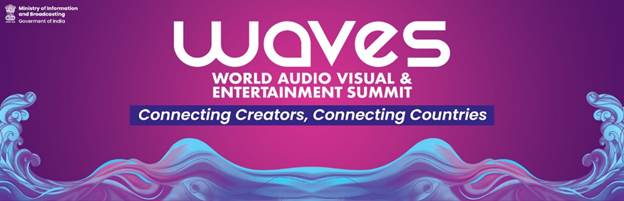
Platforms have been created to convert creative potential into commercial scale. The World Audio Visual and Entertainment Summit brought together creators, startups, investors and policymakers to facilitate deal making and cross border collaboration. WaveX has enabled startup incubation and investor engagement, while WAVES Bazaar functions as a marketplace for scripts, music, comics and audiovisual rights, promoting co production and international partnerships.
The Create in India Challenge has served as a talent discovery mechanism, identifying emerging creators and connecting them with global platforms. Together, these initiatives demonstrate a shift from conceptual promotion of creative industries to structured execution.
Live Entertainment And Urban Spillovers
India’s live entertainment landscape has evolved into a high impact experiential economy. Large scale concerts, festivals and touring circuits across cities such as Mumbai, Delhi, Bengaluru, Hyderabad and Ahmedabad are generating significant spillover effects in tourism, hospitality, logistics and urban services.
Venue infrastructure ranging from stadium scale arenas to premium cultural spaces has expanded. Behind headline performances lies an ecosystem of technicians, stage designers, sound engineers, hospitality workers and local vendors. Live entertainment now operates as a multiplier sector, energising urban economies and reinforcing India’s presence in global touring circuits.
Education And Skilling As Long Term Strategy
Creative industries are fundamentally talent driven. Recognising this, policy emphasis has shifted toward embedding creative skills within formal education systems. Plans to establish AVGC Content Creator Labs in 15,000 secondary schools and 500 colleges aim to broaden access to digital creative tools and structured training.
By integrating curriculum reform, teacher capacity building and digital infrastructure, India is constructing a talent pipeline aligned with projected industry demand of nearly two million professionals by 2030 in the AVGC sector alone.
Strategic Outlook For The Next Decade
Across classrooms, studios, coding labs, film sets and digital platforms, a cohesive creative ecosystem is taking shape. Institutions are being strengthened, capital is being mobilised and creators are being connected to global markets.
Creative industries are increasingly contributing to employment generation, export earnings and intellectual property creation. They also enhance India’s soft power by projecting cultural narratives through globally accessible platforms.
As global competition intensifies around digital content, immersive experiences and intellectual property ownership, India is positioning its creative economy as a strategic capability rather than a peripheral cultural activity. Sustained investment in skills, infrastructure and institutional frameworks will determine how effectively imagination translates into enduring economic strength.
The trajectory indicates that creativity in India is no longer an adjunct to growth. It is becoming one of its primary engines, linking economic expansion with cultural influence and technological innovation in the decade ahead.