
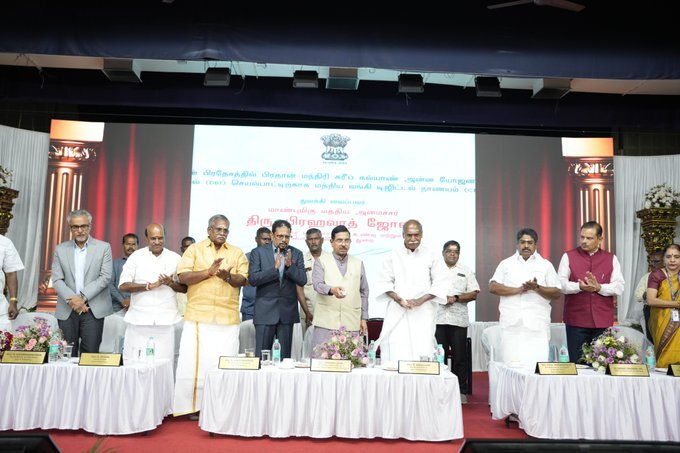
The Government of India has launched a Central Bank Digital Currency based Digital Food Currency pilot for Direct Benefit Transfer under Pradhan Mantri Garib Kalyan Anna Yojana in Puducherry, marking a major reform in the delivery of food subsidy through the Public Distribution System.
The pilot was inaugurated in Puducherry by Pralhad Joshi, Union Minister for Consumer Affairs, Food and Public Distribution, in the presence of K. Kailashnathan, Lieutenant Governor of Puducherry, and N. Rangasamy, Chief Minister of Puducherry. The event was also attended by R. Selvam, Speaker Government of Puducherry; P. R. N. Thirumurugan, Minister for Civil Supplies and Consumer Affairs; K. Lakshminarayan, Minister for Public Works; and senior officials from the Government of India, Government of Puducherry, Reserve Bank of India and Canara Bank.
Under the pilot, food subsidy will be transferred directly into beneficiaries’ CBDC wallets in the form of programmable digital rupee tokens issued by the Reserve Bank of India. These tokens will be redeemable exclusively for purchase of entitled foodgrains at authorised merchants and Fair Price Shops, ensuring purpose bound utilisation of subsidy and enhanced transparency.
Pralhad Joshi described the integration of Central Bank Digital Currency into the Public Distribution System as a transformative milestone in India’s food security architecture. He said the reform would enhance transparency, efficiency and beneficiary empowerment, ensuring that more than 80 crore beneficiaries under PMGKAY receive their entitlements with greater clarity and accountability.
He stated that digital coupons generated through the Reserve Bank of India would be credited as e rupee directly to beneficiaries. The system enables redemption through CBDC coupon or voucher codes at Fair Price Shops or merchant outlets. It is designed to address challenges related to biometric authentication and e POS operational issues while ensuring secure, traceable and real time transactions.
Pralhad Joshi highlighted that PMGKAY is the largest food security programme in the world and noted that, in addition to wheat and rice, millets are being provided to strengthen nutritional security. He said international organisations have recorded that 25 crore people have moved out of multidimensional poverty over the past 11 years. He added that recent surveys indicate household expenditure on food has declined by nearly 50 percent due to free foodgrain distribution by the Central Government and additional support from the Union Territory of Puducherry. He said savings from free foodgrain distribution are being used by families to purchase other nutritious commodities such as milk and vegetables, contributing to better health and long term human capital development.
He informed that nearly 20 lakh calls are being made every month using artificial intelligence to gather beneficiary feedback on the quantity and quality of foodgrains received. He said the CBDC pilot would soon be expanded to three to four States and Union Territories and that further rollout would be decided after detailed evaluation.
K. Kailashnathan said the launch marked a significant day for the underprivileged and working citizens of Puducherry. He emphasised that food is a fundamental human right and said both the Union and State governments are working together to ensure seamless delivery of welfare schemes. He stated that the objective is to eliminate middlemen and corruption so that benefits reach the rightful beneficiaries. He noted that the Direct Benefit Transfer system linked to Aadhaar has been functioning effectively in Puducherry and expressed confidence that CBDC integration would further enhance transparency and citizen empowerment.
N. Rangasamy welcomed the initiative and said Puducherry is already providing additional foodgrains under the Public Distribution System. He said the transfer of subsidy through CBDC wallets would increase beneficiaries’ confidence and empower them to meet their foodgrain needs independently. He described the move as a significant step in ensuring that subsidy reaches beneficiaries directly without intermediaries and reaffirmed the Union Territory’s support for the pilot.
The Secretary, Department of Food and Public Distribution, stated that the rollout of CBDC for distribution of subsidy under PMGKAY in Puducherry strengthens the Jan Dhan Aadhaar Mobile trinity and digital empowerment. Special provisions have been made to ensure inclusion of feature phone users. The system also enables beneficiaries to locate nearby authorised merchant establishments through the application. He said the CBDC based PDS model would be expanded across Puducherry and subsequently rolled out in Chandigarh and Dadra and Nagar Haveli, with plans for gradual nationwide expansion. He acknowledged the support of Reserve Bank of India, Canara Bank and the Union Territory administration in launching the pilot.
Over the past several years, the Department of Food and Public Distribution has undertaken extensive digital transformation measures, including end to end digitisation of ration cards, nationwide portability under One Nation One Ration Card, deployment of e POS devices for Aadhaar enabled authentication, real time transaction capture, the Rightful Targeting Dashboard for data driven validation, supply chain optimisation through Ann Chakra and strengthened grievance redressal through Ann Sahayata. The CBDC based Digital Food Currency pilot represents the next stage of reform by integrating a programmable sovereign digital payment layer into the Public Distribution System architecture.
The pilot, initially covering a limited number of beneficiaries, is expected to strengthen transparency, efficiency and accountability in last mile delivery of food subsidy while laying the foundation for technology driven welfare governance.